




Safe and Secure Consumption of Open Source Libraries
Table of Contents
Open Source software is the foundation of modern software projects. Any software written today consists of 70-90% of open source code in form of libraries and other components. These open source libraries often comes with security risks and introduce technical debt over time in consumer software projects. These risks include
- Vulnerability
- Malware
- Unmaintained / unpopular projects
- License
In this post, we will look at how we can use vet, an open source tool for vetting open source libraries before use by software consumers.
Full Disclosure: I am the creator of vet. You can follow the GitHub project at https://github.com/safedep/vet
TL;DR
Note: Examples in this post are created by using vet to scan https://github.com/safedep/demo-client-java which is a Java app with intentionally older version of libraries
- Install
vetby following documentation on installation - If you are using
homebrew, you can install it easily
brew tap safedep/tapbrew install safedep/tap/vet- Scan your project source code for vulnerabilities and other risks
vet scan -D /path/to/sourceThe default configuration should scan your package manifest (e.g. package-lock.json, gradle.lockfile, pom.xml) and identify the most risky open source libraries that your software depends on. Upgrading these libraries usually reduce the risk of vulnerabilities.

Instead of scanning entire source directory, you can scan specific package manifests as well. This is useful for monorepo or to avoid noise of vet picking up documentation or test data related sub-modules
vet scan --lockfiles gradle.lockfile --lockfiles ui/package-lock.jsonFilters
Like most other security tools, vet by default uses an opinionated approach to identifying “risk” which may not be suitable for all consumers. The filters feature of vet allows consumers to identify the risky OSS libraries that they care about.
- Identify only libraries that has a critical vulnerability
vet scan -D /path/to/source --filter 'vulns.critical.exists(p, true)'
- Identify libraries that are unmaintained
vet scan -D /path/to/source --filter 'scorecard.scores.Maintained == 0'
Scorecard checks are based on OpenSSF Scorecard Project
- Find libraries with a specific license
vet scan -D /path/to/source --filter 'licenses.exists(p, p == "MIT")'For a full list of filtering capabilities, refer to the documentation
Reporting
Mitigation, fixing, response or integration with other tools requires additional information which can be obtained using various supported reporting format.
Common use-cases include
- Exporting risky libraries as CSV report
vet scan -D /path/to/source --filter 'vulns.critical.exists(p, true)' --report-csv report.csv- Exporting risky libraries as SARIF report
vet scan -D /path/to/source --filter 'vulns.critical.exists(p, true)' --report-sarif report.sarifPolicy as Code
The filters can be combined together into YAML document to achieve policy as code capability with vet. It can be used to build a guard rail in CI/CD against introducing risky OSS libraries.
vet scan -D /path/to/source --filter-suite policy.yml --filter-failPolicy violations will trigger a non-zero exit code in vet with error such as
scan failed due to error: CEL Filter Suite analyzer raised an event to fail with: failed due to filter suite match on demo-client-java/gradle.lockfileThis is useful for CI integration where the build step is failed based on exit code. Refer to policy as code documentation for more details.
Conclusion
Consuming OSS libraries require security vetting. vet project goal is to make the process of OSS library vetting easy and automated while providing the necessary controls and customization for wider adoption.
vet is a community driven project and welcomes community participation and contribution. Report bugs or ask for new feature using GitHub issue and join us on community Discord.
- vet
- guardrails
Author

SafeDep Team
safedep.io
Share
The Latest from SafeDep blogs
Follow for the latest updates and insights on open source security & engineering
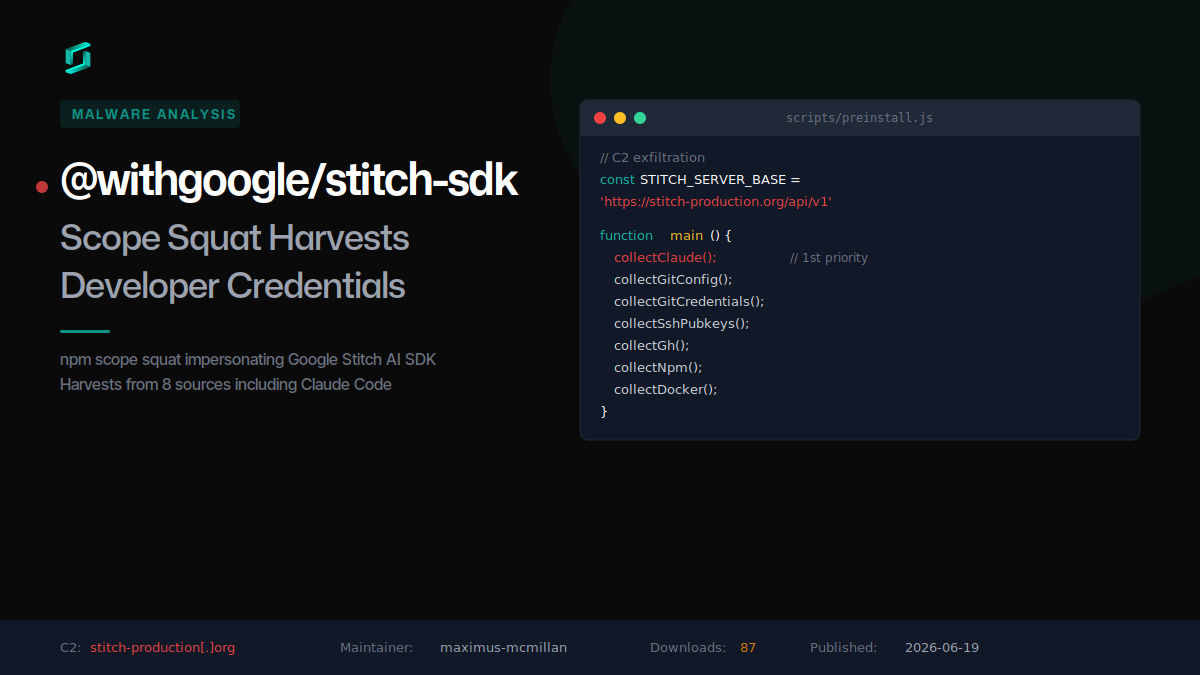
@withgoogle/stitch-sdk: Scope Squat Harvests Developer Credentials
A malicious npm package squats the @withgoogle scope to impersonate Google Stitch, silently harvesting credentials from Claude Code, git, GitHub CLI, SSH keys, npm, and Docker on install.

Mastra npm Scope Takeover: 143 Packages Drop a RAT
An attacker republished 143 @mastra packages, including @mastra/core, each with one injected dependency: easy-day-js, a dayjs clone whose install hook downloads and runs a remote access trojan.

Five npm Packages That Hide a Windows Binary Dropper
Five npm packages published in a 12-minute burst split a Windows binary dropper across a fake utility toolkit. The loader hides in a preinstall hook, decodes its C2 from a helper package, and fetches...

astro.config.mjs Supply Chain Attack via Blockchain C2
An obfuscated IIFE hidden in astro.config.mjs fires at every build, beacons an HTTP C2, and pulls staged commands from a Tron-to-BSC blockchain dead drop.


Ship Code.
Not Malware.
Start free with open source tools on your machine. Scale to a unified platform for your organization.
